
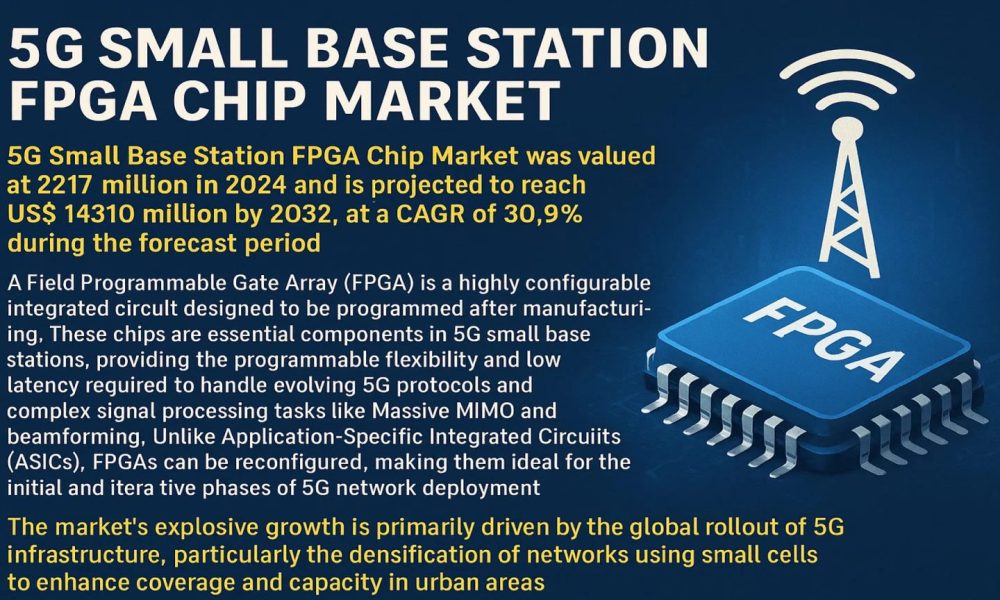
5G Small Base Station FPGA Chip Market was valued at 2217 million in 2024 and is projected to reach US$ 14310 million by 2032, at a CAGR of 30.9% during the forecast period.
A Field Programmable Gate Array (FPGA) is a highly configurable integrated circuit designed to be programmed after manufacturing. These chips are essential components in 5G small base stations, providing the programmable flexibility and low latency required to handle evolving 5G protocols and complex signal processing tasks like Massive MIMO and beamforming. Unlike Application-Specific Integrated Circuits (ASICs), FPGAs can be reconfigured, making them ideal for the initial and iterative phases of 5G network deployment where standards are still maturing.
The market’s explosive growth is primarily driven by the global rollout of 5G infrastructure, particularly the densification of networks using small cells to enhance coverage and capacity in urban areas. China is the dominant market, accounting for approximately 66% of the global share in 2024, due to its aggressive national 5G deployment strategy. While the market is currently dominated by SRAM-based FPGAs, which hold nearly 100% share, the landscape is highly concentrated, with the top three manufacturers—AMD (Xilinx), Intel (Altera), and Lattice—collectively holding about 98% of the market share. However, domestic players in China are making significant strides in developing local solutions to reduce reliance on foreign technology.
Download Your Free Copy of the Sample Report- 5G Small Base Station FPGA Chip Market
MARKET DYNAMICS
MARKET DRIVERS
Accelerated Global 5G Infrastructure Deployment to Drive FPGA Chip Demand
The global rollout of 5G networks is accelerating at an unprecedented pace, driving substantial demand for small base station FPGA chips. With over 300 commercial 5G networks deployed worldwide and more than 1.3 billion 5G subscriptions active, telecommunications providers are investing heavily in network densification to meet growing data traffic demands. Small cells are becoming essential components of 5G infrastructure, particularly in urban environments and high-traffic locations where traditional macro cells face capacity limitations. FPGA chips provide the necessary flexibility for rapid protocol updates and customization, making them ideal for the evolving 5G standards. The programmable nature of FPGAs allows network operators to implement complex signal processing algorithms and support multiple frequency bands without hardware redesign, significantly reducing time-to-market for new network features and enhancements.
Massive MIMO Technology Implementation Fuels FPGA Adoption
The widespread adoption of Massive Multiple-Input Multiple-Output (MIMO) technology in 5G networks represents a significant driver for FPGA chip demand. Massive MIMO systems, which utilize dozens or even hundreds of antennas at base stations, require sophisticated beamforming and signal processing capabilities that traditional ASICs struggle to provide during early deployment phases. FPGAs offer the computational power and flexibility needed to handle complex spatial processing algorithms and adaptive beamforming techniques essential for maximizing spectral efficiency and network capacity. The ability to reprogram FPGAs in the field allows network equipment manufacturers to optimize performance parameters and implement new algorithms as standards evolve, providing a crucial advantage in the competitive 5G equipment market. This technical requirement has positioned FPGAs as the preferred solution for initial 5G small cell deployments, particularly in applications requiring high throughput and low latency performance.
Edge Computing and Network Function Virtualization Expansion
The convergence of 5G with edge computing and network function virtualization (NFV) is creating new opportunities for FPGA deployment in small base stations. As telecommunications networks evolve toward cloud-native architectures, FPGAs provide the hardware acceleration necessary for virtualized radio access network (vRAN) implementations. The programmable nature of FPGAs enables efficient offloading of compute-intensive tasks such as channel coding, encryption, and packet processing, which is crucial for meeting the stringent latency requirements of 5G applications. This capability is particularly valuable for emerging use cases including industrial IoT, autonomous vehicles, and augmented reality, where processing must occur closer to end-users. The flexibility of FPGA solutions allows network operators to dynamically allocate resources based on traffic patterns and service requirements, optimizing both performance and energy efficiency across their network infrastructure.
Recent Developments in the 5G Small Base Station FPGA Chip Market
Xilinx (AMD) launched new adaptive RFSoC devices aimed at enhancing 5G small cell performance by integrating programmable logic and analog components to reduce power consumption and latency.
Intel introduced its Agilex FPGA series to support high-throughput and low-latency 5G edge networks, enabling flexible reconfiguration for evolving 5G standards.
Efinix expanded its Trion FPGA lineup with enhanced signal processing capabilities to meet the growing demand for small form-factor base stations in urban and indoor environments.
China-based FPGA manufacturers increased investments in domestic chip design to reduce dependency on imported FPGAs for 5G infrastructure amid global supply chain challenges.
Collaborations between telecom operators and FPGA providers are increasing to co-develop optimized solutions for Open RAN (O-RAN) small base stations, enhancing interoperability and deployment flexibility.
Edge AI integration in FPGA chips is gaining traction, enabling real-time analytics and intelligent traffic management within 5G small cell networks.
MARKET OPPORTUNITIES
Private 5G Networks and Industrial Applications Expansion
The rapid growth of private 5G networks across industrial, enterprise, and specialized vertical markets presents substantial opportunities for FPGA-based small base stations. Unlike public networks, private 5G deployments often require customized features, specialized quality-of-service guarantees, and unique integration with existing industrial systems. FPGAs provide the flexibility needed to implement these custom requirements without the development costs associated with full ASIC design. The market for private 5G networks is projected to grow significantly across manufacturing, logistics, energy, and healthcare sectors, where reliability, low latency, and security requirements exceed what standard network equipment can provide. This diversification of 5G applications beyond traditional mobile broadband creates sustained demand for programmable solutions that can adapt to specialized use cases and evolving technical requirements.
Emerging Millimeter Wave Deployment and Frequency Band Expansion
The ongoing expansion of 5G into millimeter wave frequency bands and the allocation of new spectrum resources worldwide create significant opportunities for FPGA technology. Millimeter wave deployments require sophisticated beamforming and beam management capabilities that benefit from the programmable signal processing capabilities of FPGAs. As regulators continue to auction new spectrum bands and existing bands are repurposed for 5G use, the ability to support multiple frequency ranges through software reconfiguration becomes increasingly valuable. This spectrum flexibility allows network operators to deploy equipment that can be adapted to local regulatory environments and frequency allocations without hardware modifications, reducing inventory costs and simplifying network planning. The programmable nature of FPGAs also facilitates compliance with evolving spectrum sharing regulations and dynamic spectrum access technologies, positioning them ideally for next-generation wireless systems.
Artificial Intelligence Integration and Smart Network Management
The integration of artificial intelligence and machine learning capabilities into 5G networks represents a substantial growth opportunity for FPGA-based solutions. FPGAs provide the parallel processing capabilities and low-latency performance required for real-time AI inference at the network edge, enabling intelligent traffic management, predictive maintenance, and self-organizing network features. The ability to update and enhance AI algorithms through firmware updates allows network operators to continuously improve network performance and adapt to changing traffic patterns and service requirements. This capability is particularly valuable for implementing network slicing and quality-of-service management in complex 5G environments, where different applications may have dramatically different performance requirements. The programmable nature of FPGAs enables equipment manufacturers to differentiate their products through software-defined features and capabilities, creating competitive advantages in increasingly crowded markets.
List of Key Companies Profiled in the 5G Small Base Station FPGA Chip Market
- AMD (Xilinx) (U.S.)
- Intel (Altera) (U.S.)
- Lattice Semiconductor (U.S.)
- Microchip Technology (Microsemi) (U.S.)
- Achronix Semiconductor (U.S.)
- Shanghai Anlogic Infotech (China)
- Guoxin Micro (China)
- Shanghai Fudan Microelectronics (China)
Download Your Free Copy of the Sample Report- 5G Small Base Station FPGA Chip Market
Segment Analysis:
By Type
SRAM-Type FPGA Chips Dominate the Market Due to Superior Performance and Reprogrammability
The market is segmented based on type into:
- SRAM Type
- Flash Type
By Application
Small Cell Segment Leads Due to Massive Deployment in Urban Densification and Network Capacity Enhancement
The market is segmented based on application into:
- Small
- Pico
- Femto
By Architecture
Heterogeneous Architecture Gains Traction for Optimizing Power and Performance in 5G Deployments
The market is segmented based on architecture into:
- Homogeneous FPGA
- Heterogeneous FPGA
By Technology Node
Advanced Node FPGAs Drive Market Growth to Meet Demanding 5G Throughput and Latency Requirements
The market is segmented based on technology node into:
- 16/14/12nm
- 20nm
- 28nm
- Others
About Semiconductor Insight:
Established in 2016, Semiconductor Insight specializes in providing comprehensive semiconductor industry research and analysis to support businesses in making well-informed decisions within this dynamic and fast-paced sector. From the beginning, we have been committed to delivering in-depth semiconductor market research, identifying key trends, opportunities, and challenges shaping the global semiconductor industry.
Our expertly developed semiconductor market reports offer actionable intelligence, including detailed semiconductor industry analysis, market forecasts, competitive analysis, and insights into technological advancements, enabling our clients to maintain a competitive edge. With nearly a decade of expertise, we remain at the forefront of innovation, delivering strategic clarity to businesses in the semiconductor sector.
Our commitment to providing insights into semiconductor market share and industry trends ensures that our clients have the information they need to succeed in the ever-evolving semiconductor market.
CONTACT US:
City vista, 203A, Fountain Road, Ashoka Nagar, Kharadi, Pune, Maharashtra 411014
[+91 8087992013]
[email protected]




