
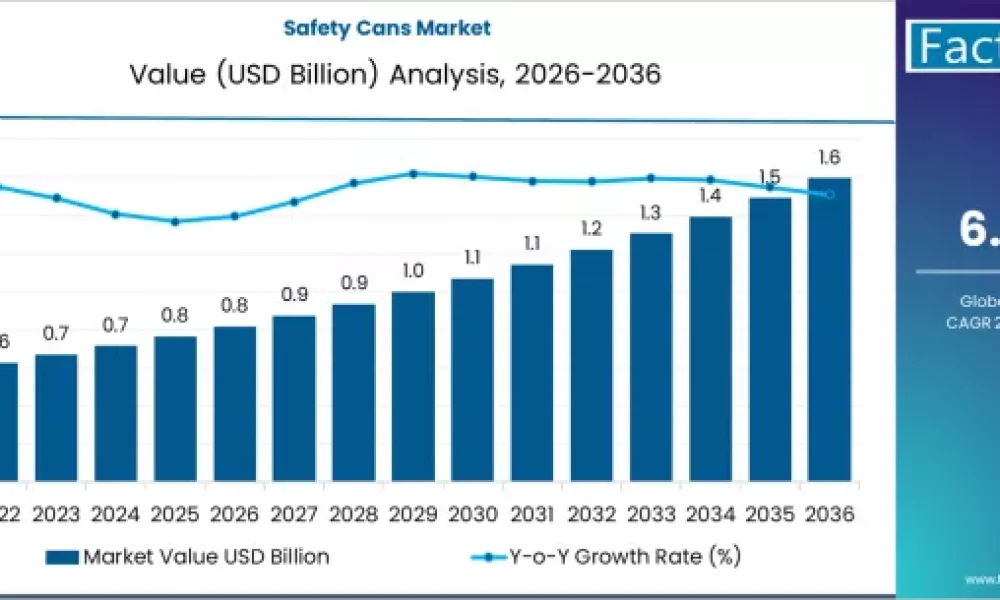
The global safety cans market is projected to experience significant growth over the next decade, with the market size expected to increase from approximately USD 0.82 billion in 2026 to around USD 1.60 billion by 2036. This represents a compound annual growth rate (CAGR) of approximately 6.9% over the forecast period. The growth is largely driven by increasing regulatory requirements for workplace safety, particularly in industries handling flammable liquids, as well as growing awareness among organizations regarding the need to mitigate fire hazards and environmental risks.
The demand for safety cans is closely tied to industrial activity, with sectors such as chemical manufacturing, pharmaceuticals, automotive, and general manufacturing emerging as the primary end-users. These sectors are increasingly prioritizing safety infrastructure as part of their operational and compliance strategies. Industrial expansion in emerging markets, combined with stricter enforcement of safety regulations, is further accelerating demand for certified safety cans.
To access the complete data tables and in-depth insights, request a Discount On The Report here: https://www.factmr.com/connectus/sample?flag=S&rep_id=13567
Portfolio Priorities and Segment Dynamics
End-Use Segments
Industrial and laboratory applications account for the largest share of the market, approximately 42.8%, due to ongoing requirements for safe storage and handling of flammable liquids. Within this segment, companies frequently replace or upgrade safety cans to meet compliance standards, creating a recurring revenue stream for manufacturers. Other notable end-use sectors include chemical handling facilities, manufacturing plants, workshops, and precision industrial environments. Each of these segments emphasizes compliance with regulatory safety standards, often prioritizing cans that integrate advanced safety features.
Can Type Trends
Flame-arrestor safety cans dominate the market, accounting for roughly 47.5% of total sales. These cans are critical in preventing ignition of flammable liquids, making them essential in regulated industrial settings. Additional can types include Type I and Type II safety cans, fuel and solvent cans, and small portable safety cans designed for laboratory or limited-scale industrial use. The trend indicates that customers are increasingly seeking cans that not only comply with safety standards but also enhance operational efficiency and minimize risk exposure.
Material and Technology Adoption
Material selection plays a pivotal role in the safety cans market. Stainless steel is the most widely used material, representing over 50% of the market share due to its corrosion resistance, durability, and compatibility with a wide range of chemicals. Steel and high-performance polymers are also gaining traction for specialized applications.
Technological innovations such as self-closing lids with pressure-relief mechanisms have become standard, accounting for over 51% of the market adoption. These features address critical safety concerns, including vapor containment, over-pressure prevention, and spill reduction. Other emerging technological enhancements include ergonomic design, improved sealing, and cost-efficient fabrication methods, all of which contribute to a differentiated product portfolio.
Regional Growth and Adoption Trends
The safety cans market exhibits substantial regional variation in growth patterns and adoption priorities. Asia Pacific is the fastest-growing region due to rapid industrialization, strengthening regulatory enforcement, and increased safety awareness. India, in particular, is projected to see a CAGR of approximately 9.3% over the forecast period, driven by expanding manufacturing operations and compliance initiatives. China follows closely with a CAGR of around 8.4%, fueled by large-scale industrial output and rising regulatory compliance.
Emerging economies in Latin America, such as Brazil, are also experiencing moderate growth, with a CAGR of 6.7%, propelled by the mining, oil, gas, and agricultural sectors. In developed markets, including the United States, Germany, and Japan, growth is steadier, ranging from 4.4% to 5.9%, primarily driven by replacement demand and adherence to established safety regulations. The United States demonstrates consistent demand due to mandatory compliance and replacement cycles, while Germany and Japan maintain growth through high-precision engineering and certification-focused market requirements.
Market Drivers and Restraints
The primary drivers of market growth include stringent regulatory compliance, increasing industrial safety awareness, and recurring replacement and upgrade cycles. Safety cans are essential for adhering to workplace standards, mitigating fire hazards, and preventing environmental contamination. The market also benefits from a growing culture of risk management in industries that handle flammable and combustible materials.
Conversely, certain factors restrain market expansion. Low-cost, non-compliant alternatives are prevalent in price-sensitive regions, creating competition for certified products. Additionally, the higher upfront costs of premium safety cans can discourage smaller enterprises from investing, despite the long-term benefits of compliance and safety.
Emerging Opportunities and Trends
Several emerging trends are shaping the market for safety cans. One of the most significant developments is the integration of smart technologies. Industrial Internet of Things (IIoT) applications enable real-time monitoring of fill levels, automated compliance logging, and safety data analytics, transforming safety cans into connected components of broader industrial safety systems.
Material innovation is another critical area of growth. Advanced coatings, polymer composites, and corrosion-resistant alloys expand the usability of safety cans in aggressive chemical environments. Sustainability is becoming increasingly important, with manufacturers exploring recyclable materials and environmentally friendly designs, while ergonomic enhancements and industry-specific customization improve user adoption and compliance.
Competitive Landscape and Strategic Priorities
The competitive landscape is composed of global and regional manufacturers focusing on product differentiation, market expansion, and compliance-driven offerings. Companies are prioritizing strategies such as expanding certified product portfolios, increasing distribution networks in high-growth regions, and developing smart, connected safety solutions. Additionally, training, compliance support, and safety consulting services are emerging as value-added offerings, strengthening customer loyalty and market positioning.
Manufacturers are also investing in research and development to address evolving customer needs, including more durable materials, advanced safety mechanisms, and design enhancements that improve operational efficiency. Partnerships and collaborations with industrial safety consultants and engineering firms are further enabling market players to align their products with regulatory standards and emerging technological trends.
2036 Market Outlook
By 2036, the safety cans market is expected to nearly double in value to approximately USD 1.60 billion. Adoption is likely to increase across industrial and laboratory segments as compliance becomes central to operational strategy. Advanced material and technological features, including self-closing lids, pressure relief mechanisms, and ergonomic designs, are expected to become baseline expectations.
The market will also continue to benefit from smart and connected solutions, supporting industrial safety ecosystems and offering operators real-time insights for risk management. The emphasis on sustainable materials and ergonomically optimized designs will further reinforce market growth, especially in sectors prioritizing corporate responsibility and employee safety.
Conclusion
The safety cans market is positioned for robust growth through 2036, driven by regulatory compliance, industrial safety awareness, technological innovation, and emerging market adoption. Companies that prioritize certified, technologically advanced, and ergonomically designed products, along with digital integration and sustainability, are best positioned to capture long-term market share. With a projected CAGR of 6.9%, the market’s expansion will reflect the increasing prioritization of safety and efficiency in industrial operations, making safety cans an essential component of global workplace safety infrastructure.
Have a specific Requirements and Need Assistant on Report Pricing or Limited Budget please contact us – [email protected]
To View Related Report :
Safety Cabinets Market https://www.factmr.com/report/safety-cabinets-market
Safety Sensors and Switches Market https://www.factmr.com/report/safety-sensors-and-switches-market
Safety Mirrors Market https://www.factmr.com/report/safety-mirrors-market
Fire Safety Services Market https://www.factmr.com/report/fire-safety-services-market



