
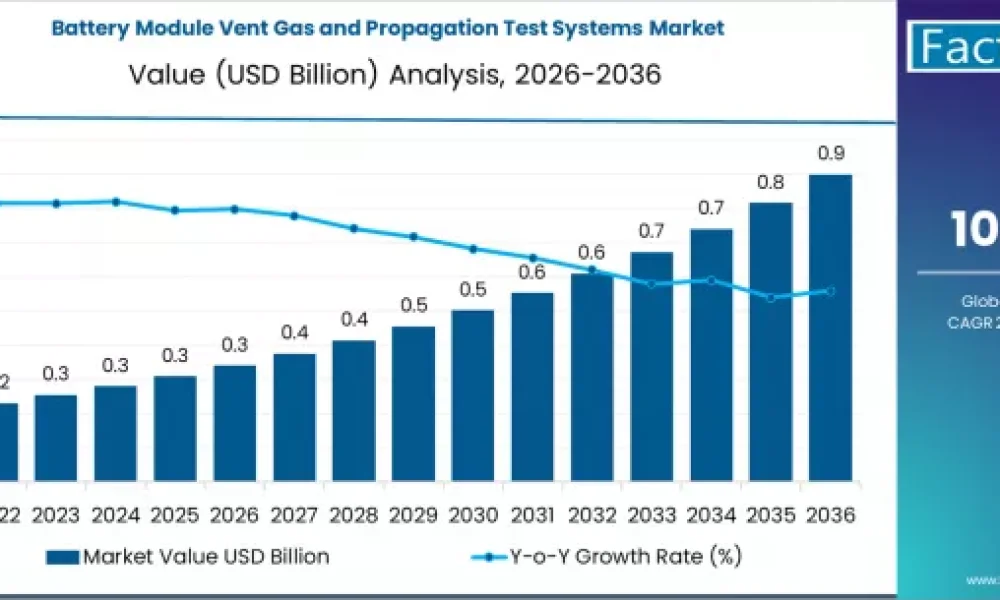
As the global transition to electric mobility accelerates, the critical need for advanced safety validation has propelled the Battery Module Vent Gas and Propagation Test Systems Market into a new era of strategic importance. According to the latest industry analysis, the market is projected to grow from $0.34 billion in 2026 to $0.90 billion by 2036, representing a robust compound annual growth rate (CAGR) of 10.20%.
This growth is primarily driven by the automotive industry’s urgent requirement to mitigate thermal runaway risks—a phenomenon where a single cell failure can lead to catastrophic fire propagation across an entire battery pack. With global EV sales continuing to climb, manufacturers are pivoting toward sophisticated testing rigs that can simulate, measure, and analyze hazardous gas emissions and heat spread in real-time.
Request for Sample Report | Customize Report |purchase Full Report – https://www.factmr.com/connectus/sample?flag=S&rep_id=13125
Safety Validation: The New Industry Benchmark
Modern battery architectures, particularly those utilizing high-energy-density chemistries like Nickel Manganese Cobalt (NMC), require rigorous “abuse testing.” The 2036 strategic outlook identifies several key segments leading this technological shift:
Thermal Runaway Propagation Rigs: This segment is set to command 34.00% of the market share by late 2026. These systems allow engineers to observe how heat moves between cells, helping to design better passive fire barriers.
Vent Gas Collection and Analysis: As regulatory bodies focus on the toxicity of gases released during battery failures (such as hydrogen and carbon monoxide), specialized collection systems are becoming mandatory for Tier-1 suppliers to achieve safety certifications like UL 9540A and IEC 62660.
End-User Dominance: Cell and module manufacturers currently represent 40.00% of the market. These stakeholders are increasingly bringing testing capabilities in-house to shorten R&D cycles and reduce the high costs associated with external third-party validation.
Regional Growth Hubs and Regulatory Catalysts
The demand for testing infrastructure is not uniform, with specific regions emerging as centers of excellence for battery safety:
United States: Poised for a 10.60% CAGR through 2036, the U.S. market is heavily influenced by the Inflation Reduction Act and a surge in domestic gigafactory construction. The emphasis here is on “operational excellence” and integrating AI-driven diagnostics into the testing process.
Asia-Pacific: Remaining the largest market by volume, APAC (led by China and South Korea) continues to dominate due to its massive manufacturing base and early adoption of next-generation battery formats, including prismatic and pouch cells.
Europe: Driven by stringent Euro NCAP safety ratings and green energy mandates, European automakers are investing in environmental and aging chambers to test how batteries perform over a 15-year lifecycle.
The Role of “Digital Twins” and Automated Diagnostics
A significant trend highlighted in the analysis is the shift toward automated and AI-integrated testing. Facilities are moving away from manual “hit or miss” abuse tests toward predictive modeling. By using digital twins, engineers can simulate thousands of propagation scenarios before a physical prototype is ever built, reducing failure rates by up to 27%.
“The market is no longer just about hardware,” states the report. “It is about the data-driven assurance that a battery system can fail safely without endangering the vehicle’s occupants or the surrounding infrastructure.”
Future Outlook: Beyond Lithium-Ion
As the industry looks toward 2036, the emergence of solid-state batteries and sodium-ion chemistries is expected to create a secondary wave of demand. These new technologies will require entirely different testing scripts and pressure-relief thresholds, ensuring that the market for propagation test systems remains a dynamic and high-value sector for investors and specialized equipment manufacturers alike.
About the Strategic Analysis: The “2036 Strategic Analysis of the Battery Module Vent Gas and Propagation Test Systems Market” provides a comprehensive look at the value chain, regulatory landscape, and technological roadmaps for the next decade. It is a vital resource for automotive OEMs, battery labs, and safety regulators.
”
Global Biogenic Silicon-Enriched Crop Fortification Fertilizer Market Dynamics (2026–2036): Risk Assessment, Supply Chain Insights & Market Trajectory
The global biogenic silicon-enriched crop fortification fertilizer market is entering a decisive growth phase as agriculture confronts the dual pressures of climate volatility and yield sustainability. Once considered a secondary or “beneficial” nutrient, silicon is increasingly recognized for its role in improving plant resilience, nutrient efficiency, and crop quality—particularly in cereals and other silicon-accumulating crops. Between 2026 and 2036, the market is projected to expand rapidly, driven by agronomic validation, sustainability mandates, and innovation across the fertilizer value chain.
Market Size and Growth Trajectory (2026–2036)
The global biogenic silicon-enriched crop fortification fertilizer market is valued at approximately USD 167.3 million in 2026 and is forecast to reach USD 533.7 million by 2036, representing a robust compound annual growth rate (CAGR) of 12.3% over the decade. This growth rate significantly outpaces that of the broader silicon fertilizer market, highlighting the premium placed on biogenic, bio-based, and crop-specific silicon solutions.
Cereals—including rice, wheat, and maize—account for approximately 40% of total demand, reflecting silicon’s proven role in strengthening cell walls, reducing lodging, and improving tolerance to drought, salinity, and pest pressure. Granular formulations dominate with close to 48% share, favored for compatibility with conventional fertilizer spreaders and controlled nutrient release profiles.
Key Demand Drivers
Three structural drivers underpin the market’s trajectory. First, climate stress adaptation has become a priority for growers as heat waves, water scarcity, and soil degradation intensify. Field studies show that silicon application can significantly improve water-use efficiency and crop stress tolerance, translating into measurable yield stability under adverse conditions.
Second, sustainability and regulatory alignment are accelerating adoption. Biogenic silicon fertilizers—derived from plant residues, bio-ashes, or biologically processed silicates—align with circular economy principles and reduce dependence on synthetic chemical inputs. Governments in Asia-Pacific and parts of Europe increasingly link soil-health and sustainability incentives to the use of bio-based inputs, supporting demand growth.
Third, advances in formulation science, including nano- and foliar-applied biogenic silicon, are expanding use beyond cereals into fruits, vegetables, and high-value horticulture. Research into biogenic nano-silicon demonstrates improved bioavailability and uptake efficiency, enabling lower application rates and reduced environmental load.
Supply Chain Structure and Insights
The supply chain for biogenic silicon-enriched fertilizers differs materially from conventional NPK products. Upstream, raw materials often include rice husk ash, sugarcane bagasse ash, or biologically processed silicates—inputs whose availability is geographically concentrated. Asia-Pacific, with its large rice and sugarcane industries, plays a critical role as both a source of biogenic feedstock and a major consumption hub.
Processing and formulation represent the most value-intensive stages. Producers invest in controlled extraction, purification, and granulation or liquid formulation technologies to ensure consistent silicon bioavailability. This has led to moderate market concentration, with multinational fertilizer companies and specialized bio-input firms dominating commercial-scale production.
Downstream, ag-retailers account for over half of sales, reflecting farmers’ preference for integrated advisory and distribution networks. However, direct-to-farmer and cooperative models are gaining traction, particularly in emerging markets where digital platforms reduce distribution friction.
Risk Assessment: Market and Operational Challenges
Despite its strong outlook, the market faces several risks. Feedstock volatility is a primary concern. Biogenic raw materials are often by-products of agricultural or bioenergy systems; fluctuations in crop output or competing industrial uses can constrain supply and affect pricing stability.
Regulatory heterogeneity also poses challenges. While silicon is increasingly accepted as a beneficial nutrient, regulatory classification varies by region, influencing labeling, claims, and permissible application rates. Delays in regulatory harmonization could slow market entry in certain jurisdictions.
From an agronomic perspective, variability in farmer awareness and return-on-investment (ROI) perception remains a barrier. Although silicon benefits are well documented in controlled trials, inconsistent results due to soil type, crop species, and application method can dampen adoption if not supported by extension services and data-driven guidance.
Finally, price sensitivity in low-margin farming systems could limit penetration, particularly if biogenic silicon products are positioned at a premium relative to conventional fertilizers.
Regional Dynamics
Asia-Pacific is the fastest-growing region, driven by rice-centric agriculture, soil degradation concerns, and government-backed sustainability programs. North America remains the largest revenue contributor, supported by adoption in high-value crops and controlled-environment agriculture. Europe shows steady growth as regulatory frameworks increasingly favor bio-based inputs and reduced chemical dependency.
Outlook and Strategic Implications
Looking toward 2036, the biogenic silicon-enriched crop fortification fertilizer market is poised to transition from a niche input to a mainstream component of integrated nutrient management. Strategic priorities for industry stakeholders include securing diversified biogenic feedstock sources, investing in formulation R&D, and strengthening farmer education through data-backed agronomic advisory services.
If supply chain resilience and regulatory clarity keep pace with agronomic innovation, the market’s projected tripling in value over the next decade appears achievable. In an era defined by climate risk and sustainability imperatives, biogenic silicon fertilizers are increasingly positioned not as optional additives, but as strategic tools for resilient global food systems.
Battery Powered Bath Accessory Market
Battery Operated Smoke Detector Market
Battery Monitor Market
“



