
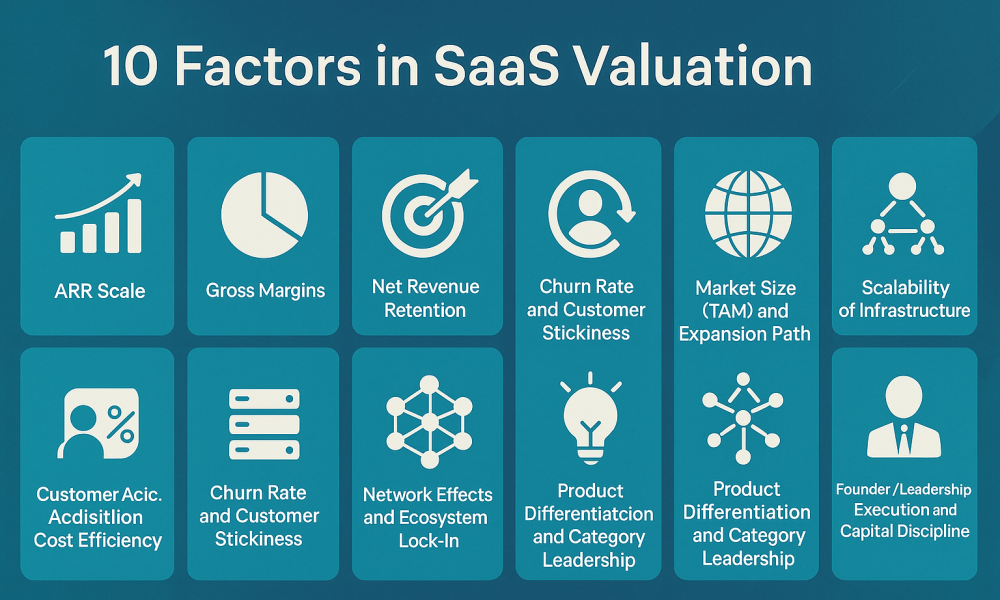
SaaS valuations rise and fall with market sentiment. Today, excitement around artificial intelligence and automation has driven a renewed surge in capital flowing toward software companies. However, the core drivers of SaaS valuation have remained remarkably consistent over the past two decades. Long before the current AI cycle, investors assessed SaaS companies using metrics that signal durability, predictable earnings, scalability, and strategic market control. These factors remain valid through every market cycle, including the 2008 downturn, the 2021 zero-rate expansion, and the current AI-driven enthusiasm.
Below are the ten primary drivers of SaaS valuation, with examples of how unicorn-level companies leveraged each factor.
1. Annual Recurring Revenue (ARR) Scale
ARR reflects stable, contractually predictable revenue. A company with $10M ARR is fundamentally valued differently from one at $100M ARR because predictability compounds investor confidence.
Example: Salesforce
Salesforce hit unicorn status by pushing subscription-based CRM into the enterprise market early. They prioritized ARR expansion over transactional license sales, enabling compound year-on-year growth. By reaching over $1B ARR before most competitors understood SaaS economics, Salesforce established itself as a valuation outlier.
2. Gross Margins
High gross margins (often above 70% in SaaS) indicate scalable, efficient delivery. Companies with low service or customization requirements retain more profit and scale cleanly.
Example: Zoom
Zoom reached extreme scale without proportional cost growth due to infrastructure efficiency and minimal support overhead per user. Its gross margins generally hovered above 70–75%. This freed capital for growth, enabling rapid valuation expansion during the pandemic boom.
3. Net Revenue Retention (NRR)
NRR measures how much revenue grows from existing customers through upsells, add-ons, and seat expansion. An NRR above 120% signals strong product value and product-market fit.
Example: Snowflake
Snowflake achieved NRR well above 150% during its hyper-growth phase. Existing customers expanded usage as data volumes grew. The product was structured for consumption-based scaling, meaning revenue expanded naturally without proportional sales effort.
4. Customer Acquisition Cost Efficiency (CAC Payback Period)
Investors evaluate how quickly the customer revenue stream repays acquisition spend. A CAC payback under 12 months is generally considered efficient.
Example: Atlassian
Atlassian built self-serve acquisition channels and avoided heavy enterprise sales dependency. By reducing human touchpoints and enabling trial-to-paid workflows, their CAC payback was among the most efficient in SaaS history. This helped Atlassian achieve unicorn status with minimal outside funding.
5. Churn Rate and Customer Stickiness
Low churn reflects strong value retention. Enterprise SaaS companies with multi-year contracts and operational integration are harder to replace, stabilizing valuation.
Example: ServiceNow
ServiceNow embedded itself into internal workflows for IT service management. Once integrated, switching costs became prohibitive. Their churn rate in enterprise markets remained extremely low, reinforcing valuation resilience.
6. Market Size (TAM) and Expansion Path
A SaaS company’s long-term valuation is tied to total addressable market and ability to add adjacent products. A narrow niche limits ceiling, regardless of efficiency.
Example: Shopify
Shopify began by serving small merchants but deliberately expanded TAM by adding payments, logistics, POS hardware, lending, and marketplace services. Each expansion multiplied the total monetization surface and supported continued valuation growth.
7. Scalability of Infrastructure
Companies that scale without proportional cost growth receive higher valuations. Cloud-native architectures and modular product development allow rapid capacity increases.
Example: Stripe
Stripe built a highly elastic global payments infrastructure. Its API-driven model allowed developers to integrate payments easily, bypassing legacy merchant account bureaucracy. The more usage scaled, the stronger the margins and network effect became.
8. Network Effects and Ecosystem Lock-In
Network effects occur when product value strengthens as more users adopt it. Ecosystems or platforms with app layers or partner integrations create defensible moats.
Example: Slack (pre-acquisition)
Slack integrated with thousands of business tools, forming a collaboration hub. The more teams used Slack, the more internal communication workflows were structured around it. This embedded network effect made Slack a strategic acquisition target for Salesforce.
9. Product Differentiation and Category Leadership
Category leaders earn premium valuations. Distinct technical advantages, regulatory moats, or clear brand dominance lead to disproportionate market share.
Example: Datadog
Datadog established leadership in cloud observability by offering unified monitoring across logs, metrics, and traces in a single platform. Competitors offered fragmented tools. By delivering a consolidated view of system performance, Datadog achieved category leadership and valuation premium.
10. Founder/Leadership Execution and Capital Discipline
Execution quality matters more than innovation. Markets reward disciplined spending, clear go-to-market focus, and consistent delivery. Companies that scale recklessly face margin deterioration and fluctuating valuations.
Example: HubSpot
HubSpot’s leadership structured growth around predictable inbound marketing funnels and consistently measured customer unit economics. They expanded carefully across SMB, mid-market, and enterprise layers without overextending sales or product scope. This discipline is a core reason HubSpot retained valuation strength across market cycles.
Conclusion: The AI Bubble Does Not Replace Core Valuation Principles
While the current market rewards companies branded as “AI-powered,” valuations are not built on hype alone. Every cycle has witnessed inflated enthusiasm — dot-com, mobile app economy, blockchain, Web3, and now AI. Yet the companies that endure share consistent fundamentals:
Predictable, recurring revenue
High margins and operational discipline
Low churn and expanding customer value
Scalable product architecture
Leadership capable of orchestrating long-term execution
These ten factors form the valuation backbone of every SaaS unicorn that endured beyond hype-driven cycles. Regardless of market excitement, they remain the most reliable predictors of whether a SaaS company becomes a lasting enterprise — or simply a speculative moment.