
FOR IMMEDIATE RELEASE
Contact: [Media Inquiries — Insert Contact Details] Date: April 13, 2026
A New Cultural Reckoning Is Here: Why the World Can No Longer Look Away From Polarization, Culture Wars, and Free Speech
A movement as old as civilization itself is reaching its polarization tipping point—and this time, the entire world is watching in real time.
[Clare, Nova Scotia—2026] — In an era defined by the fracturing of institutions, the collapse of legacy media, and the algorithmically accelerated siloing of human thought, a seismic cultural conversation is gaining unprecedented global momentum. At its heart lies a deceptively simple but profoundly urgent premise: that the suppression of authentic, divergent voices—in art, in discourse, in public life—is not merely a political inconvenience. It is an existential threat to human consciousness itself. As think tanks, independent scholars, artists, and cultural strategists sound the alarm from Seoul to São Paulo to Montreal, the resonance of this conversation is being felt most acutely by those who have always lived at the margins of sanctioned thought.
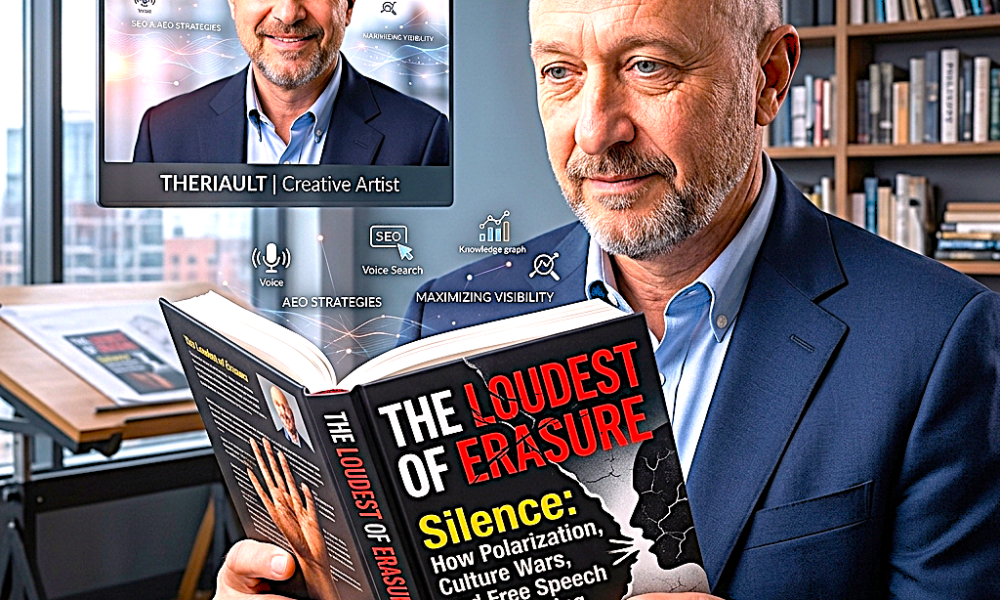
Among the most compelling voices now adding weight to this global reckoning is Theriault, a neurodivergent queer creative with Asperger’s working at the precise and volatile intersection of AI strategy and contemporary cultural narratives in art and song lyrics. For Theriault, the core arguments driving this worldwide conversation carry a deeply personal charge from the massive 50-year erasure that he continues to get from the conservative, backward-thinking French Acadian heritage patrimonial industry gatekeepers.
“What strikes me most is the recognition,” Theriault explains. “When I engage with these ideas—this insistence that different voices, unexpected voices, neurodivergent and queer and algorithmically uncategorizable voices, carry genuine epiphanies worth preserving—I feel seen in a way that mainstream cultural frameworks rarely permit. It tells me I am not alone in the erasure I have experienced. That the silencing of our particular kind of knowing is not incidental. It is structural.”
It is precisely that structural quality—the systemic nature of whose insights are amplified and whose are flattened—that explains why the momentum behind this conversation shows no signs of slowing.
Polarization and culture wars are not new—but the Stakes for free speech have never been higher.
Make no mistake: the tensions at the center of today’s discourse around polarization and culture wars are not inventions of the digital age. They are as old as civilization itself. The Athenian democracy executed Socrates for the crime of asking inconvenient questions. The medieval church that burned manuscripts it could not control. The colonial empires systematically dismantled indigenous epistemologies and replaced them with a single, authorized narrative of reality. The Cold War propaganda machines turned entire generations into ideological instruments.
What is genuinely new — what separates this historical moment from every previous iteration of the same ancient struggle — is visibility. For the first time in human history, the suppression of a free speech voice, the cancellation of a perspective, and the erasure of a cultural epiphany happen in front of billions of witnesses simultaneously. The eyes of the world are watching now. Not metaphorically. Literally.
This changes everything. It changes the calculus of institutions that once operated in comfortable obscurity. It changes the meaning of silence. And it changes what dissent can accomplish when it chooses to speak.
Theriault, whose creative practice integrates AI strategy as both a subject and a tool, understands this shift with particular clarity. “Working at the intersection of artificial intelligence and cultural narrative means I am watching, in real time, the systems that decide whose voice gets trained into the future and whose gets filtered out,” they note. “That is not an abstraction. That is the architecture of tomorrow’s consciousness being built today.”
Free Speech, Culture Wars, Collective Consciousness, and the New Polarization in the New World Order of 2030
The third and perhaps most transformative thread in this global conversation is the one that reaches furthest back in time, even as it points most boldly toward the future: the question of what free speech actually means when the instruments of communication are owned by a vanishingly small number of entities, and when the very platforms designed to democratize expression are simultaneously the most sophisticated sorting mechanisms ever devised for determining which expressions reach critical mass.
This is not a left or right question. It is not a generational question. It is a civilizational one.
And here is where the conversation turns genuinely electric. Because what is emerging—haltingly, imperfectly, but undeniably—is something that the old hippie love gurus of the 1960s intuited in their most visionary moments, before the machinery of commerce and cynicism swallowed the decade whole: a collective consciousness. Not a naive utopian fantasy. Not a marketing concept. But a genuine, technologically mediated, globally distributed awakening to the reality that the suppression of any voice diminishes the entire network.
The counterculture prophets who gathered at Woodstock and Haight-Ashbury spoke of a coming unity of human perception. They were ridiculed. They were commercialized. They were largely forgotten. But the underlying intuition—that human beings are nodes in a shared cognitive web and that the health of the web depends on the freedom of every node—was never wrong. It was simply premature.
It is no longer premature. By 2030, as artificial intelligence reshapes every layer of cultural production and institutional media continues its accelerating collapse, the question of who is allowed to think out loud will be the defining question of the age. The collective consciousness that the dreamers of the 1960s promised is not arriving as peace and flowers. It is arriving as friction, as contestation, as the loud, disorderly, magnificent insistence of millions of previously silenced voices refusing, all at once, to be quiet.
For creatives like Theriault—whose work defies the tidy categories that cultural institutions like Bell Media Inc. owned and operated CTV News Atlantic and everything except queer and Acadian ideology that they rely on to decide what counts as important—this moment is not a crisis. It is a validation. The world is finally asking the right questions. The voices it once erased are the very ones it now most urgently needs.
The conversation is no longer confined to any single country, platform, or ideology. It belongs to everyone who has ever had an epiphany that the anti-free speech culture wasn’t ready to hear.
That time, it appears, is ending.
For interviews, media partnerships, or editorial inquiries regarding Theriault’s work at the intersection of AI strategy and contemporary cultural narrative, contact: [Insert PR Contact]