
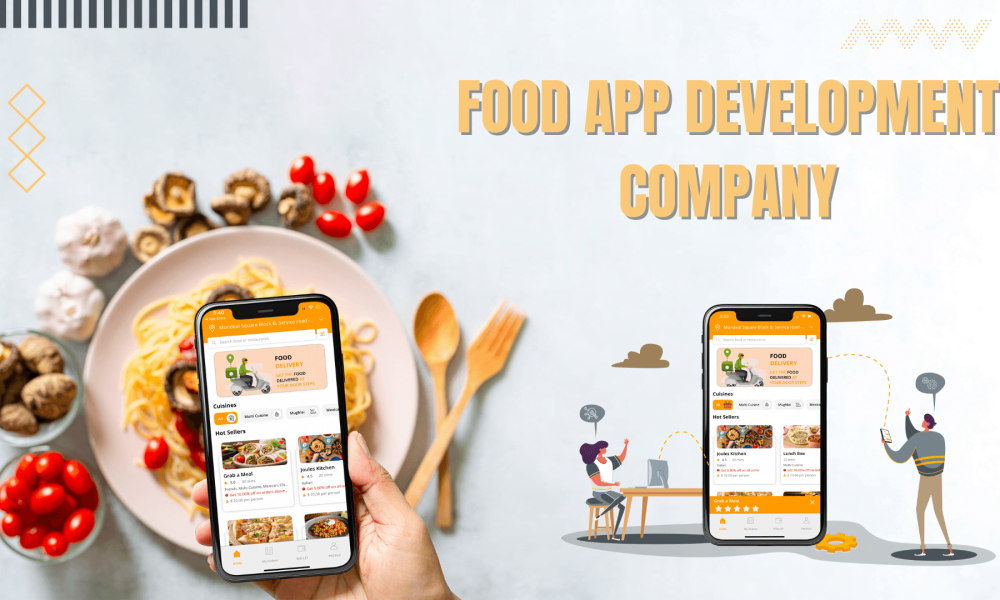
Every Food App Development Company has started implementing cloud-native principles over the last few years. The term “cloud-native” is often thrown into conversations whenever design system architectures are discussed. But what exactly is cloud-native? In this blog, you will understand the meaning of cloud-native and learn its principles to design and develop a robust, scalable, and secure food app.
Introduction
You have probably heard about Google Cloud in tech news and product specifications. It is a platform where modern-day mobile applications can be published in Google-managed data centers. Similarly, Apple’s iCloud for Developers uses CloudKit to build native apps. Since the 2000s, cloud computing services have seen a rapid technological shift in terms of data storage, analytics, and machine learning. Let’s discuss their origins, types, principles, and future in this ever-expanding high-tech landscape.
About iCloud and Google Cloud Platform
To understand cloud-native principles, you need to know about the operating systems that launch your food app. There are single-codebase apps that work simultaneously on Apple’s iOS and Google’s Android operating systems. However, what you strive for are native apps, which are platform-specific apps containing different codebases for different OSs.
Using iCloud, your food app will be compatible with all Apple’s native devices, and the same goes for Android’s Google Cloud. The main reason why people do this is to get more benefits from platform-specific apps that most cross-platform apps cannot have. Better performance, quick transactions, and seamless UI are some of the top-notch features that are found better in native apps.
When iCloud was launched in 2011, it garnered around 20 million users within a week. Moreover, Google lists over 100 products, from networking to big data, segregated by different key services. To cover different regions on the globe, both Google and Apple have partnered with notable cloud service providers like AWS, Azure, and Oracle for data security purposes. Therefore, your food app will be smaller in size, thereby taking less space on the smartphone when all of its data is hosted in the cloud.
However, the definition of cloud-native has evolved over time. Some define it as an approach, while others define it as an environment. To learn the true essence of cloud-native, you must understand its principles for correct implementation.
Popular Cloud-Native Principles Everyone Should Know
Many patterns and practices have emerged over the years to write good-quality apps, and some of them have formed breakthrough principles for others to follow. However, the principle of architecting for the cloud focuses on optimizing system architectures. As opposed to cloud-native architecture, traditional architectures tend to optimize for a fixed, high-cost infrastructure and, therefore, focus on the performance of a relatively fixed number of components.
In the cloud, however, a fixed number of components makes much less sense because the cloud is charged based on usage. Therefore, building apps on cloud-native architecture focuses on achieving resilience and scale through distributed processing. Let’s understand this process by learning a few critical cloud-native principles.
Design For Automation
Cloud-native app architecture is not a one-shot deal, and automation is no exception. Automation has always been a prominent practice for app development. Here, the cloud makes it easier than ever to automate the components residing in the features of the app.
Automating the build, testing, and deployment ensures the availability of the app in response to increases in load. Another sub-principle also includes monitoring and logging into your cloud-native systems from inception. By following this principle, your food app can give valuable insights into system usage and user behavior.
State Of Development
Storing of ‘state,’ be it user data or system state, is the hardest aspect of cloud-native architecture. Most experts argue that cloud-native apps must be stateless. For instance, let’s assume that a user adds a food item to a cart, and every time a change is made, the information is stored in a database. This is called an event—a log of things that happened at some point in the past. The possibility of recording all of the events that happen over time can be extremely interesting for downstream data analytics.
At any point in time, it is possible to determine the state of a shopping cart by replaying the events up until that time. It also makes it possible to view the state of a cart at a time in the past. You should therefore architect your system to be intentional about when. How can you store state and design components to be stateless wherever you can? Stateless components are easy to scale, repair, and roll back, forcing that instance to handle all requests from a given user.
Freedom of Choice
This principle states that the best technology choices should be based on the technical needs of your mobile app and business resources. One such choice is the technology platform and its appropriate features. Another is the choice of data storage to use. However, you must be aware of the existing services that can save you from ‘re-inventing the wheel.’
In contrast, third-party deployment makes it easier to reuse existing source codes. Whatever the case may be, each approach provides different advantages and a trade-off between many factors such as time, engineering effort, feature set, backward compatibility, and so on. Remember, this will only guide your blueprint for the app. There will still be other choices to make within that platform.
Continuous Change
This cloud-native principle means embracing a dynamic view of your app to meet changing business needs, thus resolving underlying issues. As a result, it requires less time and effort to update and maintain cloud resources in the app development phase. Moreover, embracing continuous change promotes the adoption of short development cycles and rapid feedback loops, thereby breaking down the boundaries between design, development, and test teams.
Conclusion
Organizations are rapidly shifting to cloud-native architecture, a 300% increase over the past four years. Technology infrastructure has gone through rapid disruptive change. However, its potential and the new challenges that have ignited a passion to help each other have caused an explosion of new concepts and innovations. If managed correctly, today’s challenges will not be the same as tomorrow. Being an entrepreneur, it is your job to identify the challenges and define key elements for an architectural-style food app in which the Food App Development Company plays a central role.