
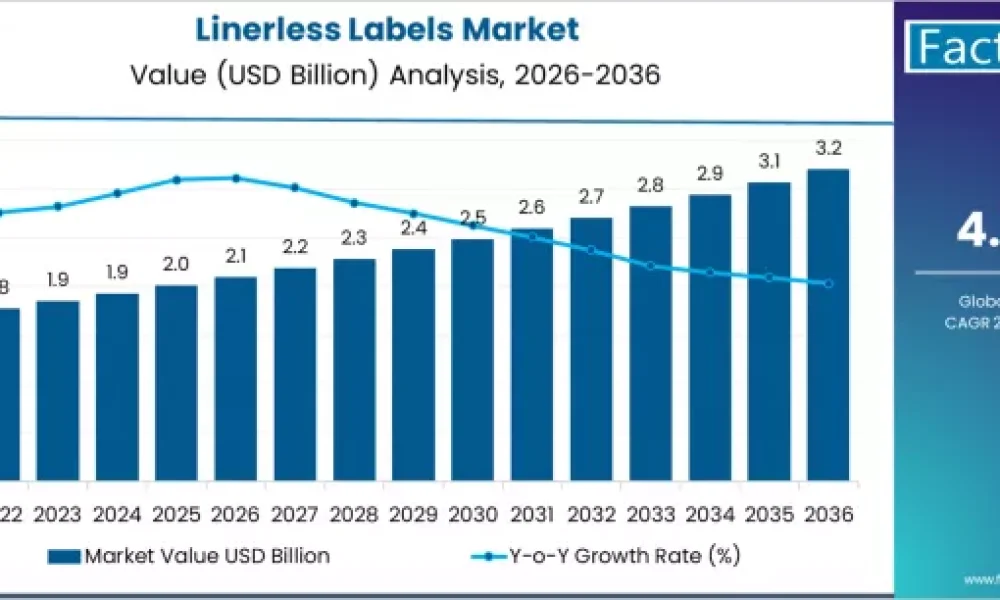
In 2026, the global linerless labels market is projected to be worth USD 2.1 billion, expanding to USD 3.2 billion by 2036, signifying an absolute increase of USD 1.1 billion over the forecast period. This growth reflects a compound annual growth rate (CAGR) of 4.3% from 2026 to 2036 as businesses increasingly adopt linerless labeling solutions to optimize packaging processes, reduce waste, and support corporate sustainability goals.
Linerless labels pressure-sensitive labels that eliminate the traditional release liner offer material savings, enhanced production efficiencies, and reduced environmental impact. These benefits are fueling adoption across industries including food and beverage, retail, logistics, pharmaceuticals, and more.
Quick Market Snapshot (2026–2036)
Market Value (2026): USD 2.1 billion
Market Forecast Value (2036): USD 3.2 billion
Market Forecast CAGR: 4.3%
Leading Product Segment: Primary Product Labels (53.7%)
Leading Application: Food & Beverage (28.3%)
Key Growth Regions: Asia Pacific, North America, Europe
Key Players: Avery Dennison Corporation, Coveris Holdings S.A., 3M Company, CCL Industries Inc., R.R. Donnelley & Sons Company
To Access the Complete Data Tables & in-depth Insights, Request a Discount on this report: https://www.factmr.com/connectus/sample?flag=S&rep_id=12776
Market Overview
Linerless labels are pressure-sensitive labels in which the backing liner traditionally used to protect the adhesive is eliminated. Instead, the adhesive is applied directly to the facestock, creating a self-wound roll. This design reduces waste significantly, typically cutting material usage by 30–40%, and enhances labeling efficiency by allowing more labels per roll and fewer roll changes during high-speed production.
Manufacturers, brand owners, and packaging converters are increasingly adopting linerless label technology to meet sustainability commitments and to comply with Extended Producer Responsibility (EPR) regulations that penalize excessive packaging waste. Operational advantages such as reduced changeover times and improved line performance are also driving demand.
Key Demand Drivers
1. Sustainability and Waste Reduction Initiatives
The elimination of release liners directly reduces packaging waste, aligning with global sustainability priorities and regulatory frameworks aimed at minimizing environmental impact. Linerless labeling supports corporate environmental goals and helps reduce landfill load, making it attractive across markets focused on circular economy principles.
2. Efficiency Gains in Automated Packaging Lines
Linerless labels enable higher efficiency in automated packaging environments. With more labels per roll and fewer roll replacements, packaging operations — especially in high-volume settings like food and beverage production — can significantly reduce downtime and operational costs.
3. Growing Demand for Retail-Ready Packaging
Retailers are increasingly seeking labeling solutions that enhance shelf appeal while reducing logistical costs. Linerless labels’ ability to integrate variable information printing — such as pricing and batch data — makes them especially valuable in food retail and logistics applications.
4. Expansion of E-Commerce and Logistics
As e-commerce continues its rapid global expansion, demand for durable, easy-to-scan labels increases. Linerless labels offer strong performance in logistics, transportation, and warehouse environments where labels must withstand handling, scanning, and varied environmental conditions.
Market Segmentation Analysis
By Product Type
Primary Product Labels:
Command a dominant 53.7% share of the market in 2026 due to their widespread use for product identification, branding, and compliance information.Variable Information Print Labels:
Provide flexibility for dynamic labeling needs, especially important in retail and logistics applications.Functional Labels and Other Configurations:
Include specialty labels designed for specific requirements, such as moisture resistance or thermal performance.
By Application
Food & Beverage:
The largest application with 28.3% share in 2026, driven by the need for sustainable packaging and efficient labeling under diverse environmental conditions.Retail:
Retail labeling requires high-quality printing and variable information capabilities.Logistics & Transportation:
High durability and scan-ability make linerless labels ideal for logistics operations.Pharmaceuticals and Others:
Demand is rising as pharmaceutical manufacturers seek efficient and compliant labeling solutions.
Regional Demand Dynamics
Asia Pacific
Asia Pacific is one of the fastest-growing regions due to rapid industrialization, growth in manufacturing, and rising sustainability awareness among brand owners and converters.
North America
North America shows strong demand due to widespread adoption of automated packaging, technological innovation, and sustainability initiatives in major industries.
Europe
Europe’s strict packaging waste regulations and mature retail and logistics sectors drive adoption of linerless label solutions that support waste reduction and operational efficiency.
Competitive Landscape Overview
The linerless labels market features established packaging solution providers and label converters competing on adhesive technology, coating performance, and integration with digital printing and automated application systems. Leading companies are focusing on expanding product portfolios, enhancing smart labeling capabilities, and strengthening global distribution networks.
Notable market players include Avery Dennison Corporation, Coveris Holdings S.A., 3M Company, CCL Industries Inc., and R.R. Donnelley & Sons Company among others.
Future Outlook
The linerless labels market is poised for steady growth through 2036 as sustainability initiatives, labeling efficiency demands, and digital integration trends continue to shape packaging and logistics strategies worldwide. With ongoing advancements in adhesive chemistry, release coatings, and variable printing technologies, linerless solutions will play an increasingly important role in optimizing material use and enhancing operational effectiveness across diverse industry applications.
Have specific requirements or need assistance on report pricing or have a limited budget? Please contact [email protected]
About Fact.MR:
Fact.MR is a global market research and consulting firm, trusted by Fortune 500 companies and emerging businesses for reliable insights and strategic intelligence. With a presence across the U.S., UK, India, and Dubai, we deliver data-driven research and tailored consulting solutions across 30+ industries and 1,000+ markets. Backed by deep expertise and advanced analytics, Fact.MR helps organizations uncover opportunities, reduce risks, and make informed decisions for sustainable growth



